Showing posts with label Reed specifications. Show all posts
Showing posts with label Reed specifications. Show all posts
Thursday, November 19, 2020
Wednesday, May 8, 2019
REED'S SPECIFICATIONS, CALCULATION OF DENT WIRE THICKNESS
REED'S SPECIFICATIONS:
Overall reed width =?
Overall reed height 99 mm
Working reed height = 75 mm
Air space = 65 - 70 %
Dent wire thickness = ?
Dent width = 4 mm
Dent' material = standard steel wire
Height of top baulk = 8 mm
Height of bottom baulk = 16 mm
Reed thickness = 8mm
Here we will discuss reed's specifications for the following quantity.
Fabric width = 120”
EPI = 110
PPI. = 90
Warp count. = 40s
Weft count = 40s
Reed. = 106 ( stock port system)


Reed marks in the fabric
Temple mark in the fabric
Water mark in the fabric
Oil mark, dust mark, grease mark and stain mark in the fabric
Abrasion Mark in the fabric
Reed of the loom is a very important part. It is directly associated with fabric quality and looms efficiency. Improper reed specifications directly affect the warp breakages. High warp breakage rate due to improper reed specifications reflects in the form of poor fabric quality. Weaver also faces trouble during the passing of knots through the dent of the reed. If the material of dent wire is not proper as per fabric quality to be woven. The dent wire gets band during broken ends drawing. If the material is not proper, the rust can be deposited on the surface of the dent wire. This rust causes high warp breakage during weaving.
Now the question arises, how to place an order to reed supplier for particular fabric quality.
A weaver should consider following reed's specifications before placing an order to the reed supplier:
Overall reed width
Overall reed height
Working reed height
Dent wire thickness
Dent width
Dent' material
Height of top baulk
Height of bottom baulk
Reed thickness
Air space
Reed count
Overall Reed height, working reed height, dent width, the height of top and bottom baulk, reed thickness and air space are fixed for a particular loom by loom manufacturer.
Overall reed width =?
Overall reed height 99 mm
Working reed height = 75 mm
Air space = 65 - 70 %
Dent wire thickness = ?
Dent width = 4 mm
Dent' material = standard steel wire
Height of top baulk = 8 mm
Height of bottom baulk = 16 mm
Reed thickness = 8mm
Here we will discuss reed's specifications for the following quantity.
Fabric width = 120”
EPI = 110
PPI. = 90
Warp count. = 40s
Weft count = 40s
Reed. = 106 ( stock port system)
Reed width: this parameter is decided after calculating the reed space to be used during the weaving of a particular fabric.
we have to weave 120” fabric width. Now we calculate the required reed space for 120” wide fabric. Suppose reed space comes 124”. Now we will find out the overall reed width.

Dent thickness: It is a very important specification of the reed. It plays a decisive role in the calculation of air space. The method of calculating the dent thickness is given below:


Please click on the below video link to watch the full article in Hindi:
You may also be interested in the following articles:
Temple mark in the fabric
Water mark in the fabric
Oil mark, dust mark, grease mark and stain mark in the fabric
Abrasion Mark in the fabric
Subscribe to:
Posts (Atom)
Featured Post
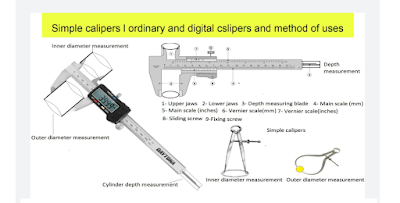
Simple calipers and vernier calipers, method of uses and calculations
Calipers: The calipers are very useful instruments. These instruments are used to measure the diameter of the cylinder, bore, bearing size, ...
-
 If you are searching for genuine hand woven, sustainable, and eco – friendly warm shawls, stoles, and scarves, the Himalayan weavers is off...
 -
 please click on the below link to read this article in Hindi यार्न की परिभाषा और यार्न के विभिन्न प्रकार या यार्न का वर्गीकरण VARIOUS TYPE...
 -
 CARDING: The carding is the second process of spinning which converts fed material (lap) into the uniform strand of fibres called “...
 -
 please click on the below link to read this article in Hindi एक सिस्टम से दूसरे सिस्टम में यार्न काउंट का रूपांतरण CONVERSION OF YARN COUN...