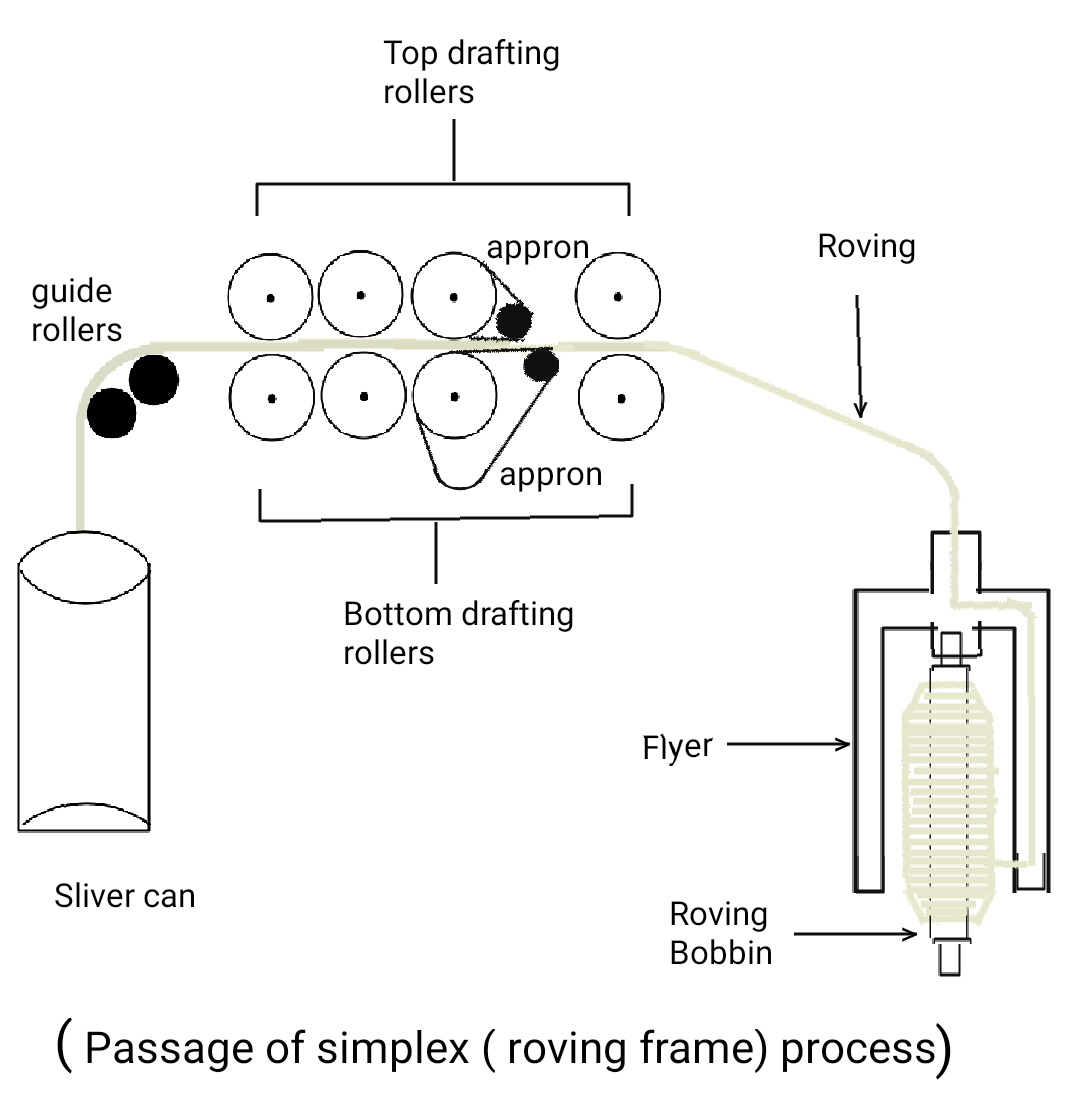
PROCSS PARAMETERS OF SIMPLEX (ROVING) PROCESS
The process parameters used in the simplex or roving frame are given below:
• Roving hank
• Roving tension
• Break draft
• Type of drafting
• Roller setting
• Twist multiplier
• End breakages rate
Roving hank:
It is the linear density (weight per unit length or length per unit weight) of roving. Generally, the number of hanks of 840 yards in a pound is called roving hank.
Roving tension:
The roving tension is an important factor that highly influences the production and quality performance of simplex machines.
There are three types of roving tensions that occur in the simplex process:
• The roving tension at the starting point of winding of roving gets affected by empty bobbin diameter and initial position of transmission belt on the cone drum mechanism.
• The roving tension during building motion depends upon the specifications of the ratchet wheel and lifter wheel. The difference between the peripheral speeds of the flyer and bobbin is kept the same. It is kept a little higher than the delivered length by the front drafting roller.
• The roving tension during the reversal of direction of bobbin rail is controlled by using the correct ratchet wheel. It depends upon the proper movement of the ratchet wheel. If the movement of it is not properly adjusted, the roving tension during reversing motion varies. In modern simplex machines, the bobbin speed, bobbin rail speed and flyer speed is regulated and determined by the digitally controlled electronic device. All the required setting parameters are programmed into the computer.
Drafting arrangement:
• The drafting system is inclined at an angle of 150 degrees. This inclination of the drafting system helps to make smooth fibres flow from drafting rollers toward the roving bobbin.
• This inclination of the drafting system in the simplex machine helps to prevent the breakage of roving to be produced.
• The amount of draft ranges between 5–20 in the simplex process.
• The surface speed of the front drafting roller is kept constant because of roving bobbin winding process need a constant delivery rate from the front roller. It helps to improve control over roving to be produced.
Break draft:
The important object of the break draft in the simplex machine is to make fibres parallel and straight in the sliver.
The level of break draft is always kept low because it helps to improve the uniformity of sliver. The factors affecting the break draft are given below:
The level of break draft is always kept low because it helps to improve the uniformity of sliver. The factors affecting the break draft are given below:
• Since the more volume of the material needs a higher degree of preparation so that it needs a higher break draft.
• If the material to be processed contains more moisture content, it needs a higher break draft in the simplex process.
• If rollers are close then normal. The more break draft is applied if rollers are placed close to each other in the drafting system.
• The long-staple fibres need a higher break draft in the simplex process.
• The value of employed break draft ranges from 1.13 to 1.35.
Main draft:
The draft acting in the real drafting region (where actual drafting takes place) is called the main draft.
Tension draft:
The main objective of the tension draft is to maintain better and adequate tension to the sliver. In this zone actually, the finer count for the roving frame is already achieved but after coming out from the front roller nip twist has to be inserted, for this, it’s important to keep good evenness throughout the sliver.
Effect of roller setting in simplex frame:
A fibre is gripped in both the nips of rollers. Then there are chances of fibre breakage which result in more quality irregularities in the material. This setting is done precisely by considering the staple length of fibre to be processed. First of all the closest possible setting is done. Then the unevenness percentage of produced roving is analysed and corrections are made accordingly.
The factors affecting twist multiplier:
• The factors influencing the twist multiplier are given below:
• The coarser roving needs a lower twist multiplier to hold the fibres together due to higher cohesion force among the more fibres present in the roving.
• The long-staple fibres require less twist multiplier in roving.
• If the speed of the simplex machine increases, it exerts more stress and tension on the roving. Therefore twist multiplier is increased to reduce the chances of roving breakage.
• If the moisture content of the material to be processed is higher, it needs a lower amount of twist multiplier.
• When the speed of the flyer gets increased, the value of the twist multiplier is also increased to reduce the roving breakage.
Please click on the below video link to watch the full article in Hindi:
You may also be interested in the following articles: