Showing posts with label weave repeat. Show all posts
Showing posts with label weave repeat. Show all posts
Thursday, November 19, 2020
Sunday, April 28, 2019
WOVEN FABRIC WEAVE OR DESIGN ANALYSIS
WOVEN FABRIC WEAVE OR DESIGN ANALYSIS:
The analysis of the design or weave of the woven fabric is a very important job. It needs a very high degree of care ness and preciseness. Since we know that the woven fabric consists of two series of yarn. The threads running in the longitudinal direction is called warp threads or ends. The yarn running in the transverse direction is called weft threads or pick. In the woven fabric, the ends and picks intersect with one another at a right angle. Before knowing about weave or design analysis, it is very important to know about the following terms.
WEAVE:
The order of interlacement of ends and picks in the fabric is called a weave of the fabric.
DRAFT:
The order of drawing the ends through the eye of Heald wire of Heald shafts and the dent of the reed is called a draft.
PEG PLAN:
The order of the lifting of the Heald shafts according to weave is called peg plan.
HOW TO ANALYSE THE WEAVE OF THE FABRIC:
The analysis of the weave of a fabric is a very difficult job. If we start weave analysis systematically, it gets easy. Before describing the procedure of weave or design analysis, we will tell you about basic weaves.
Plain weave: the repeat of plain weave is possible in minimum of two ends and two picks. Every end changes the up and down position regularly in the fabric.

Plain weave: the repeat of plain weave is possible in a minimum of two ends and two picks. Every end changes the up and down position regularly in the fabric.
Twill weave: the twill weave is possible with a minimum of three ends and three picks. The diagonal lines appear in this weave.
Satin weave: this weave is possible with a minimum of 5 ends and 5 picks. The lustre of satin weave is very good.
ANALYSIS OF WEAVE OR DESIGN OF THE FABRIC, DRAFT AND PEG PLAN:
The analysis of the weave of a fabric is a very difficult job. If we start weave analysis systematically, it becomes easy. Before describing the procedure of weave or design analysis, we will tell you about basic weaves.
Plain weave: the repeat of plain weave is possible in a minimum of two ends and two picks. Every end changes the up and down position regularly in the fabric.
Twill weave: the twill weave is possible with a minimum of three ends and three picks. The diagonal lines appear in this weave.
Satin weave: this weave is possible with a minimum of 5 ends and 5 picks. The lustre of satin weave is very good.
The weave analysis of any given swath is carried out in various steps.
In the first step of weave analysis, the correct repeat of the weave is identified and marked. The number of ends per repeat and the number of picks per repeat is found out with the help of counting glass.
In the second step, the up and down movement of ends and picks are read and are noted on a graph paper. The up and down movement of anyone end is noted on a graph paper. Now, this end is taken out from the fabric swatch. Now the up and down movement of the next end is noted. This process is repeated till the completion of the reading of the up and down movement of the full weave repeat.
In the next step, the draft and peg plan are noted on the graph paper. The systematic way of weave or design analysis is given below:

Please don't forget to share this article with your friends if you find this information useful for you. Your comments are the most welcome to improve further this article.
Please click on the below video link to watch the full article in Hindi:
You may also be interested in the following articles:
Subscribe to:
Posts (Atom)
Featured Post
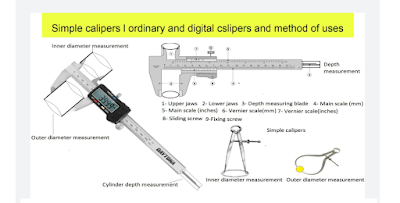
Simple calipers and vernier calipers, method of uses and calculations
Calipers: The calipers are very useful instruments. These instruments are used to measure the diameter of the cylinder, bore, bearing size, ...
-
 If you are searching for genuine hand woven, sustainable, and eco – friendly warm shawls, stoles, and scarves, the Himalayan weavers is off...
 -
 please click on the below link to read this article in Hindi यार्न की परिभाषा और यार्न के विभिन्न प्रकार या यार्न का वर्गीकरण VARIOUS TYPE...
 -
 CARDING: The carding is the second process of spinning which converts fed material (lap) into the uniform strand of fibres called “...
 -
 please click on the below link to read this article in Hindi एक सिस्टम से दूसरे सिस्टम में यार्न काउंट का रूपांतरण CONVERSION OF YARN COUN...